



Why Matches Reveal the Truth About Your Skill
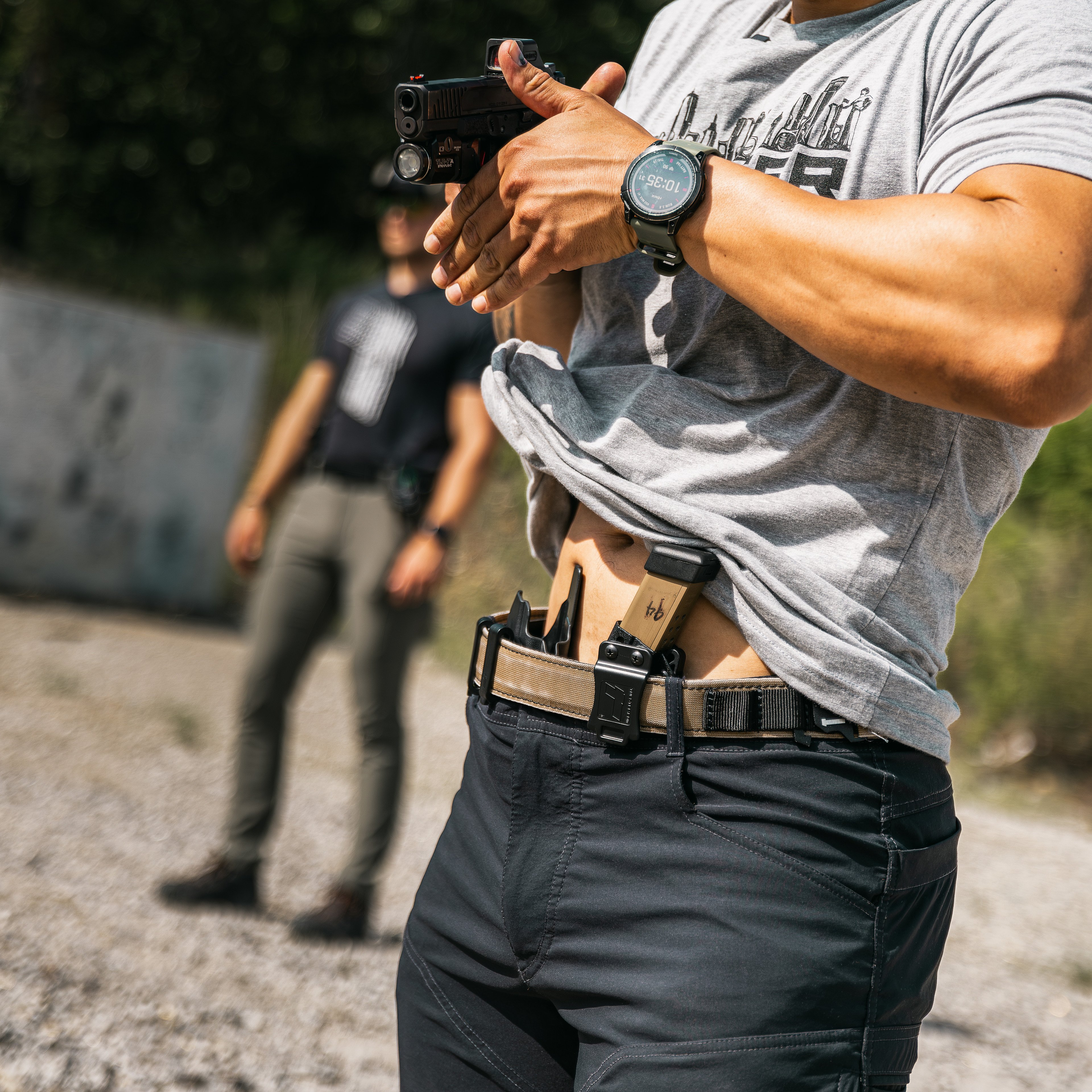
Hunter Constantine has built an amazing community of real shooters. Many of course running his world-renowned BELT for concealment purposes. This match was a great test for pushing EDC setups to the limits. Especially, since this was a match run completely from concealment.
If you have never shot a match, just know that there is a major difference between casually shooting at the range and performing under pressure.
That difference becomes painfully clear the moment the timer goes off at a match like the PCSL BELT Defensive Championship.
Competitive shooting events expose weaknesses that flat range sessions often hide. They force shooters to perform with urgency, accountability, movement, decision-making, and consequence. And for many concealed carriers and firearms enthusiasts, that experience becomes one of the most valuable forms of training they can get.
Matches like The BELT Defensive Championship are more than just a shooting event—they're a reality check.
Why Defensive Shooting Matches Matter
A lot of shooters believe they’re more prepared than they actually are.
Static lane shooting can create false confidence because:
- Targets don’t move
- There’s no pressure
- There’s no timer
- There’s no consequence for mistakes
- Reloads happen whenever convenient
- Movement is limited or nonexistent
Matches completely change that environment.
The moment performance becomes measurable, the truth starts showing up.
Defensive shooting competitions force you to:
- Draw under time pressure
- Process stage plans quickly
- Move efficiently
- Manage recoil under stress
- Shoot accurately at speed
- Handle malfunctions or mistakes calmly
That combination reveals where your real skill level actually sits.
The Timer Doesn’t Lie
One of the biggest lessons shooters learn at events like the BELT Defensive Championship is that the shot timer exposes everything.
You may feel fast during practice.
But when you’re:
- On the clock
- Surrounded by experienced shooters
- Managing adrenaline
- Trying to balance speed and accuracy
…you quickly find out where your inefficiencies live.
The timer reveals:
- Slow draws
- Hesitant reloads
- Poor transitions
- Inefficient movement
- Weak recoil management
- Mental hesitation
And that’s valuable.
Because improvement only happens when weaknesses become visible.
Shooting Matches Build Pressure Management
Stress changes performance.
Fine motor skills degrade. Decision-making slows down. Vision narrows. Even experienced shooters can begin fumbling simple tasks once pressure enters the equation.
This is exactly why competition matters.
Matches provide a controlled environment where shooters can experience:
- Performance anxiety
- Adrenaline management
- Public accountability
- Time pressure
- Mental recovery after mistakes
Without needing a real-world emergency to discover those limitations.
That experience helps build composure.
And composure matters more than most people realize.
You Learn More From Failure Than Success
One of the most valuable parts of shooting competitions is that mistakes become immediate feedback.
A missed shot, a bad reload, poor movement, or a mental lapse all become impossible to ignore.
That can be uncomfortable—but it’s productive.
The shooters who improve the fastest are usually the ones willing to:
- Compete consistently
- Accept criticism
- Analyze performance honestly
- Train their weak points afterward
Defensive matches remove ego from the equation quickly.
The scoreboard tells the truth.
The BELT Defensive Championship Emphasizes Practical Skill
Unlike purely game-focused competitions, defensive-oriented events like the BELT Defensive Championship often emphasize practical firearm handling and realistic shooting scenarios.
That means competitors may encounter:
- Positional shooting
- Movement-based stages
- Cover usage
- Realistic engagement distances
- Reload management under stress
- Problem-solving during courses of fire
This creates a more rounded test of capability instead of just raw speed.
For concealed carriers and preparedness-minded shooters, that matters.
Because defensive shooting is not just marksmanship—it’s performance under pressure.
Competition Reveals Gear Problems Too
Matches don’t just expose shooter weaknesses. They expose equipment weaknesses.
Many shooters discover:
- Poor holster retention
- Bad belt setups
- Inconsistent magazine placement
- Unreliable optics
- Weak concealment setups
- Gear that fails under movement
before they ever discover those problems in a more serious situation.
That alone makes competition worth pursuing. For this match, Tim rocked the ARC Holster with two Echo Mag Carriers.
The best gear setups are proven through repetition, movement, and stress—not social media photos.
Why Every Concealed Carrier Should Shoot Matches
Some concealed carriers avoid competition because they believe it’s “just a game.”
That misses the point entirely.
The value isn’t pretending that matches are identical to real-life defensive encounters. The value is learning how you perform when pressure, speed, movement, and accountability are introduced simultaneously.
Competition helps develop:
- Safe gun handling
- Faster target acquisition
- Better recoil control
- Efficient reloads
- Movement skills
- Stress management
- Performance consistency
Those skills absolutely transfer.
No, competition is not a replacement for defensive training.
But it is one of the best pressure-testing environments available to ordinary shooters.
Humility Is Good for Growth
One of the healthiest things a shooter can experience is realizing there are levels to this.
Shooting around highly skilled competitors changes perspective quickly.
You begin noticing:
- How efficiently advanced shooters move
- How disciplined their transitions are
- How clean their reloads look
- How calm they remain under pressure
That exposure raises standards.
And raising standards leads to improvement.
The shooters who stagnate are usually the ones who never test themselves publicly.
Community Matters Too
Another overlooked benefit of matches like the BELT Defensive Championship is the community aspect.
Competitive shooting introduces you to:
- More experienced shooters
- Instructors
- Gear specialists
- Training opportunities
- Different shooting philosophies
You learn faster around people who push performance seriously.
That environment accelerates growth far beyond isolated range sessions.
If you carry a firearm, train seriously, or care about preparedness, you should eventually test yourself in an environment where performance becomes measurable.
Because skill feels very different when the timer starts.
And sometimes the fastest path to improvement is discovering where you truly stand.