



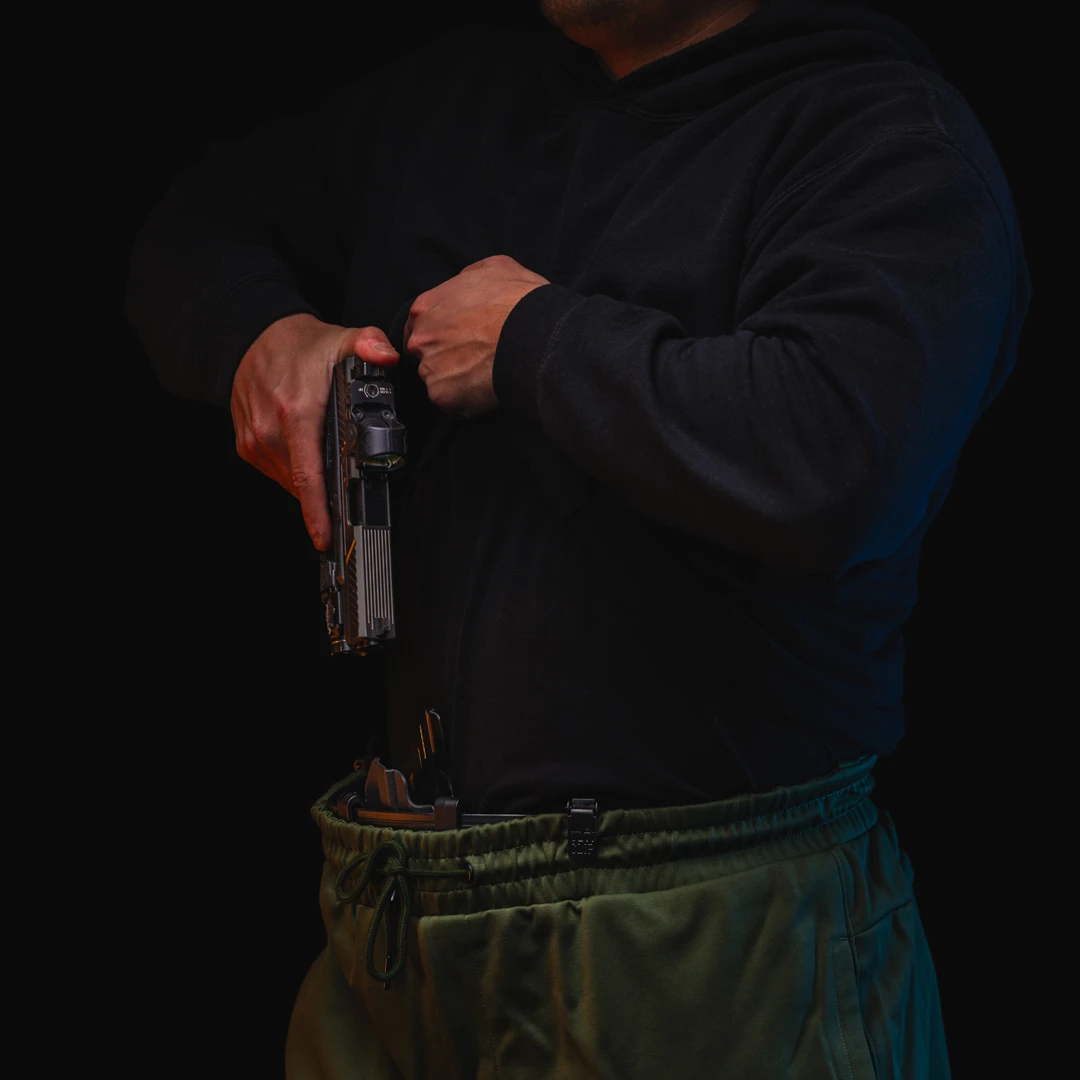
How to Appendix Carry Comfortably: Seven Adjustments That Fix Most Problems
The short answer: Comfortable appendix carry comes from setup more than toughing it out. Start with a stiff gun belt. Place the holster between 12:30 and 1:30, beside the hip crease rather than over it. Set the ride height so the grip sits just above the belt, and add a claw or wing to pull the grip in. Use a wedge if the muzzle digs in. Then give your body about two weeks to adjust.
Most appendix discomfort is a setup problem
If you've tried appendix carry and quit, you're in good company. Most people who give up on AIWB put an appendix holster on a department-store belt, wore it in the same spot they'd carry a phone, and spent a day feeling the muzzle at every stoplight. The position wasn't the problem. Every variable around it was set to default.
We've been carrying since 2004 and building holsters since the garage days. Here's the order we'd adjust things in, from the change that matters most to the one that matters least. (If you haven't decided whether appendix is right for you, start with our AIWB vs. 3 o'clock vs. 4 o'clock guide first.)
1. Start with a real gun belt
A holster is only as stable as the thing holding it. A thin fashion belt lets the holster rotate, the grip flop outward, and the muzzle shift as you move. All three feel like discomfort, and all three cause printing. A dedicated gun belt like our Kore Essentials options holds the holster in one plane all day.
If you change only one thing on this list, change the belt.
2. Find your spot: 12:30 to 1:30, not dead center
For a right-handed carrier, most comfortable appendix positions sit between 12:30 and 1:30 on the clock face. That puts the holster just inside the hip crease, where your leg bends when you sit. The exact spot is personal: move the holster a half inch at a time, sit down, stand up, and repeat.
As a general rule, slimmer carriers often go closer to 12:30, while carriers with more midsection tend to land nearer 1:30 or 2:00. A holster sitting right on the crease will dig every time you sit. Slide it a little either way, and the problem usually disappears.
3. Set ride height so the grip just clears the belt
Ride height is how deep the holster sits in your waistband. If it's too high, the grip pokes out and prints. If it's too low, you can't get a full firing grip on the draw. Start with the bottom of the grip just above the top of your belt, so you can wrap your hand around it without digging. Then lower it a step if you can still get a clean, high grip.
4. Use cant to match how you sit
Cant is the angle of the gun in the holster. Appendix carriers usually run zero cant or a slight forward cant (muzzle angled slightly toward the centerline). Cant changes where the muzzle sits against your thigh when you're seated, so if one leg takes the pressure every time you sit, cant is the first fix to try. Tulster's Profile and Profile+ offer adjustable cant up to 30° for exactly this.
5. Add a claw or wing to pull the grip in
At appendix, the grip wants to tip away from your body. A claw (also called a wing) presses against the back of your belt and levers the grip back toward you. That reduces printing, and it also stops the grip from rocking against your stomach as you move.
Tulster gives you three ways to get one. The OATH ships with the ModWing installed. The ARC includes the Tulster Wing. On the Profile and Profile+, you can add the SideKick, which mounts to the trigger guard. Our claw explainer goes deeper on how they work.
6. Add a wedge if the muzzle digs
A claw manages the grip. Our Tulster wedge manages the muzzle. It's a foam pad on the body side of the holster, near the bottom, that tilts the muzzle end away from your body and pushes the grip in even further. If you feel the bottom of the holster more than the top, especially when sitting, a wedge is the fix. Carriers with a rounder midsection often find a wedge is what makes appendix carry work at all.
7. Size your waistband for the holster
IWB carry puts something between you and your pants. Most carriers need about an inch more waist, so going up one size in pants or loosening the belt a notch is normal. A waistband that's too tight turns even a perfect holster into a pressure point.
What about sitting and driving?
Appendix is one of the better positions for driving, because the gun sits in front of the hip instead of being pinned between your back and the seat. If it digs when you sit, the fix is almost always position (step 2), cant (step 4), or a wedge (step 6). It's rarely the position itself. Try the adjustments in that order.
Holster safely, every time
Comfort counts for nothing if the gun goes back in carelessly. With appendix carry, the muzzle points down past your body, so reholstering deserves full attention. Clear your cover garment completely. Keep your finger off the trigger and outside the guard. Tilt your hips slightly forward so the muzzle angles away from your leg. Watch the gun go in, and do it slowly. Never reholster while seated, and never push through resistance. If something stops the gun, take it out and find out what it is.
Give it two weeks
Even a dialed-in setup feels foreign at first. Wear it at home for a few hours a day before committing to a full day out. Most carriers who make the adjustments above say appendix feels normal within a couple of weeks, and many find it more comfortable than the hip carry they started with.
FAQ
Why does appendix carry hurt when I sit down? Usually the holster is sitting right on the hip crease, the cant is pushing the muzzle into your thigh, or the bottom of the holster needs a wedge. Move the holster half an inch, adjust the cant, or add a wedge, in that order.
Can bigger guys appendix carry? Many do. Carriers with more midsection tend to do best around 1:30 to 2:00, with a claw and a wedge, and with a shorter-gripped pistol. Position and wedge choice matter more than body type alone.
What is the best ride height for appendix carry? Start with the bottom of the grip just above the belt line. Lower it if you can still get a full firing grip, and raise it if you can't.
Do I need a special holster for appendix carry? Yes. Use a holster designed for appendix carry, with full trigger guard coverage, a stiff shell that doesn't collapse, and a way to add a claw. Every Tulster IWB holster is built for both AIWB and strong-side carry.
How long does it take to get used to appendix carry? Most carriers adjust in about two weeks of regular wear, once the belt, position, and claw are set correctly.