



AIWB vs. 3 O'Clock vs. 4 O'Clock Carry: Which Is Right for You?
Where you carry your gun matters more than most new carriers expect. The position you choose affects how fast you can draw, how well the gun conceals, how comfortable it is after eight hours, and how naturally your hand finds the grip under stress. Pick wrong, and you'll either leave the gun at home or spend months fighting your setup.
AIWB (appendix inside the waistband), 3 o'clock strong-side, and 4 o'clock kidney — these three positions account for the vast majority of IWB carry. Each has genuine advantages and real drawbacks. Which one wins depends on your body, your daily routine, and how you train. This guide breaks all three down so you can make an informed choice rather than defaulting to whatever holster came in the box.
A Quick Note on the Clock System
Carry position is typically described using a clock face oriented around your body. 12 o'clock is the front center (your belt buckle). 3 o'clock is directly on your dominant-side hip. 6 o'clock is the small of your back. Working backwards from 3, you hit 4 o'clock at roughly the kidney area, and 5 o'clock approaching the small of the back.
AIWB — appendix inside the waistband — typically sits between 12 and 2 o'clock for right-handed carriers, though some prefer 1 o'clock on the centerline. The specific number matters less than understanding where the gun sits relative to your hip bone, your seated posture, and your draw stroke.
AIWB (Appendix Carry): 12 to 2 O'Clock
Appendix carry has become the dominant choice among serious concealed carriers over the last decade, and for good reason. It offers a faster draw, better retention under a physical threat, and — counterintuitively — often better concealment than hip carry for many body types.
Why It Works
The draw from appendix puts the gun in front of your hip, where your hands naturally hang at rest. Your draw stroke is shorter, more direct, and doesn't require you to reach behind your body. In timed drills, most trained shooters are measurably faster from AIWB than from strong-side, and the draw is easier to execute from a seated position — including behind a steering wheel — because the gun isn't pinned between your body and the seat back.
Retention is the other underappreciated advantage. With the gun in front of your hip, you can cover and protect it with your body or forearm in a struggle. Strong-side carry puts the gun on the side or behind you, where it's harder to protect and easier for a third party to access.
Concealment from AIWB is also better than most people expect. The front of the torso is relatively flat compared to the curve over the hip, and the natural drape of a shirt in front hides the grip more forgivingly than behind the hip. With a claw attachment — a small plastic piece that leverages the grip inward against your belt — most carriers can run a full-size pistol under an untucked t-shirt without obvious printing.
The Real Drawbacks
Comfort is the main barrier. AIWB puts the holster against your lower abdomen, which means the muzzle end presses against your inner thigh or groin area, especially when seated. For slender builds, this is manageable with the right holster setup. For carriers with more abdominal mass, it's often genuinely uncomfortable, and no amount of holster adjustment fully resolves it.
Holstering safety deserves serious attention with AIWB. Because the muzzle is pointed toward your femoral artery, a negligent discharge during holstering — especially with a limp grip or a loose cover garment snagged in the trigger — can be catastrophic. AIWB demands strict holstering discipline: look the gun into the holster, don't rush, and make sure the path is clear before you seat the gun. This isn't a reason to avoid AIWB, but it's a reason to train holstering with the same rigor as the draw.
Who AIWB Works Best For
- Slender to athletic builds who don't have significant abdominal mass
- Carriers who spend significant time seated — desk workers, drivers
- Those who train regularly and want the fastest possible draw
- Anyone prioritizing concealment under lighter or more form-fitting clothing
AIWB in one line: Fastest draw, best concealment for many builds — demands a well-designed holster and disciplined holstering habits.
3 O'Clock Carry: Strong-Side Hip
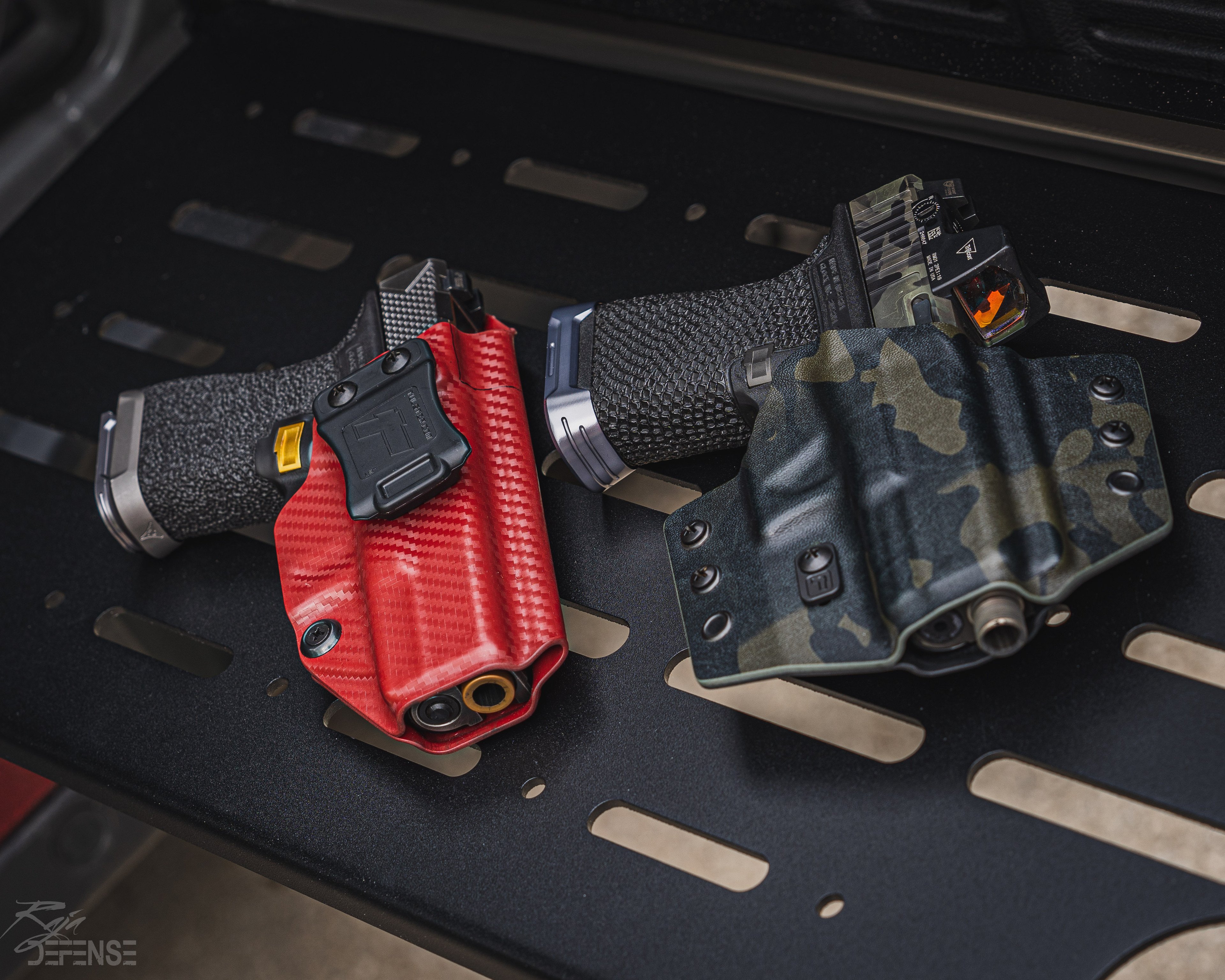
Three o'clock is what most people picture when they think of a holster — the gun rides directly on the dominant-side hip, muzzle down, grip accessible at the natural position of the hand. It's where duty holsters sit, where many first-time carriers start, and for good reason: it's intuitive. For this reason, Tulster launched the Contour Series. The Contour naturally hugs your hip for optimal concealment and comfort. It is an OWB (outside-the-waistband) holster, so keep that in mind when reading.
Why It Works
The 3 o'clock draw is natural. Your arm swings to your side, your hand finds the grip at its lowest hanging point, and you draw straight up and out. There's no rotation, no reaching behind your body, and the motion is easy to train because it maps closely to how the arm naturally moves.
For taller or longer-torso carriers, 3 o'clock is often the most comfortable position standing and walking. The gun sits on the widest part of the hip, which distributes weight well and keeps the holster stable. A quality gun belt makes this even better — the holster barely moves.
Printing is often less of a concern at 3 o'clock than people expect. The hip is the body's natural widest point, and a flat Kydex holster against the hip adds minimal visible bulk under a cover garment. Strong-side carry is also easier to dress around than AIWB because the gun isn't in a high-flex area of the body.
The Real Drawbacks
Seated access is the biggest limitation. When you sit down, the gun moves with your hip, pressing against the seat back or the car door and rotating slightly forward. Drawing from a seated position requires more awkward movement — the gun is essentially behind your body rather than in front of it. In a vehicle, this can be genuinely difficult.
For shorter or wider carriers, 3 o'clock can dig into the hip bone, especially when seated. The grip also has a tendency to flare outward slightly at this position because the hip curves away from the body, which can cause more printing than expected despite the holster's low profile.
Who 3 O'Clock Works Best For
- Taller or longer-torso carriers with a straight-through hip geometry
- Those transitioning from duty or OWB carry who want a familiar position
- Carriers who spend most of their day standing or walking
- Anyone who finds AIWB uncomfortable but wants a fast, natural draw
3 o'clock in one line: Natural, intuitive draw with good standing comfort — seated access and hip-flare printing are the main tradeoffs.
4 O'Clock Carry: Behind the Hip (Kidney)
Four o'clock positions the holster just behind the dominant hip, over the kidney area. It's the most popular strong-side position for carriers who want maximum concealment while standing, and it's a particularly good fit for carriers who can't comfortably run AIWB. A great option here is the OATH Series. Its singular and adjustable DCC clip makes for a comfortable option to "set it and forget it" until you need it.
Why It Works
Concealment at 4 o'clock is excellent. The gun sits in the natural curve of the lower back, where the body's own contour helps hide the grip. A slight forward cant — 10 to 15 degrees of FBI tilt — tucks the grip even further into the body. For carriers with a pronounced curve to their lower back, 4 o'clock can be nearly invisible under an untucked shirt.
Comfort while standing and walking is also strong at this position. The holster isn't at the hip's pivot point, so it doesn't dig into the hip bone. Many carriers who find 3 o'clock uncomfortable over long days find 4 o'clock significantly better.
The Real Drawbacks
The draw from 4 o'clock requires reaching behind your body — your elbow clears your hip, your hand rotates back, and you pull the gun forward and up. It's a longer, more complex motion than either AIWB or 3 o'clock, and it's harder to train to high speed. Under stress, especially if your dominant hand is compromised or occupied, a behind-the-hip draw is significantly harder to execute than a frontal or side draw.
Seated access is even more limited than at 3 o'clock. In a chair or vehicle, the gun is pinned against the seat back, making any draw from a seated position extremely difficult. Some carriers address this by shifting the holster forward when they know they'll be seated for extended periods, but this defeats the concealment advantage.
Small-of-back carry (5–6 o'clock) is an extreme version of this tradeoff and is worth mentioning here because it's often suggested to beginners: the concealment can be excellent, but the draw is slow, seated access is nearly impossible, and falling or being pushed against a hard surface with a gun at the small of your back creates real injury risk. If you're considering behind-the-hip carry, 4 o'clock is a far better choice than SOB.
Who 4 O'Clock Works Best For
- Carriers who prioritize concealment over draw speed
- Larger or shorter carriers who find AIWB and 3 o'clock uncomfortable
- Those who spend most of their time standing or walking, not seated
- Carriers with a pronounced lower back curve that naturally tuck the grip
4 o'clock in one line: Excellent concealment, comfortable all-day carry — the slowest draw of the three and the hardest to access while seated.
AIWB vs. 3 O'Clock vs. 4 O'Clock: How They Compare
Draw Speed
AIWB is fastest for most trained carriers because the draw path is shorter and more direct. Three o'clock is close behind when standing. Four o'clock is the slowest of the three, requiring the most complex arm motion. That said, carry position isn't a substitute for training — a well-practiced 4 o'clock draw beats an untrained AIWB draw every time.
Concealment
At 4 o'clock, the body's natural curve hides the gun for many builds. AIWB with a claw attachment can match or beat it for slimmer carriers. Three o'clock is competitive, but the grip's tendency to flare outward at the hip makes it slightly more challenging under form-fitting clothing. Body type plays a bigger role here than holster design alone.
Seated Comfort and Access
AIWB wins this category for most people. Strong-side and behind-the-hip positions push the gun against the seat, restrict natural hip flexion, and make seated drawing significantly harder. Drivers who spend hours in a vehicle should weigh this heavily when choosing a position.
All-Day Wearability
This is the most personal variable. Slender carriers often find AIWB comfortable for full days with the right holster. Many carriers find 4 o'clock the most comfortable long-haul position because it doesn't hit the hip bone and the gun rides in the back's natural curve. Three o'clock falls in the middle. The honest answer is that you won't know until you carry each position for a few weeks.
Safety Considerations
AIWB requires the most deliberate holstering practice because the muzzle points toward high-consequence anatomy. Strong-side and kidney carry are more forgiving of sloppy holstering from a pure muzzle-direction standpoint. This doesn't make AIWB dangerous — millions of people carry appendix safely every day — but it does mean holstering discipline is non-negotiable.
How to Actually Choose Your Carry Position
Start with your body type. If you have significant abdominal mass, AIWB is going to be uncomfortable regardless of holster quality. Start at 3 or 4 o'clock, get comfortable carrying consistently, and revisit AIWB later if your circumstances change.
Think about your daily environment. If you're in a car or behind a desk for six or more hours a day, AIWB's seated access advantage is meaningful. If you're on your feet most of the day, strong-side or kidney carry might serve you better.
Consider your clothing. AIWB works best with an untucked cover garment. Strong-side and kidney carry can be easier to dress around, including with tucked shirts if you use appropriate clips or loops.
Try before committing. Borrow a holster, use a rental range setup, or buy a mid-tier holster specifically to test a position before investing in a full kit. Your body will tell you more in two weeks of daily carry than any guide can tell you in advance.
Most experienced carriers end up with AIWB or 4 o'clock as their primary position, with the other as a backup for specific situations. Having the flexibility to carry in more than one position — with properly set-up holsters for each — is a genuine advantage.
Your Holster Has to Match the Position
The best carry position in the world won't work with the wrong holster for it. A holster designed for strong-side carry often has the wrong cant range for AIWB, wrong clip placement, and no provision for a concealment claw. A true AIWB holster is typically shorter (muzzle doesn't extend as far into the crotch area), has a more aggressive cant range, and is designed to accept a claw or wedge accessory.
At Tulster, the Profile IWB is built to work across carry positions — adjustable cant from 0 to 30 degrees, easy-on/easy-off clip design, and compatibility with the SideKick claw for AIWB carry where printing is the primary concern.
Whatever holster you choose, make sure it's purpose-made for the position you intend to carry. The geometry is different, and a holster fighting your position will make even a good carry technique feel worse than it should.
Bottom Line
There's no universally correct carry position. AIWB offers the fastest draw and best seated access, but demands a suitable body type and strict holstering habits. Three o'clock is natural and easy to learn, but struggles for larger carriers and seated situations. Four o'clock delivers excellent concealment and all-day comfort but gives up draw speed and seated access.
Choose the position that fits your body, your environment, and your training — then get a holster purpose-built for it and carry it consistently. That combination beats any debate about which position is theoretically best.
Find Tulster holsters built for every carry position at tulster.com — same-day shipping, lifetime warranty, made in Oklahoma.