



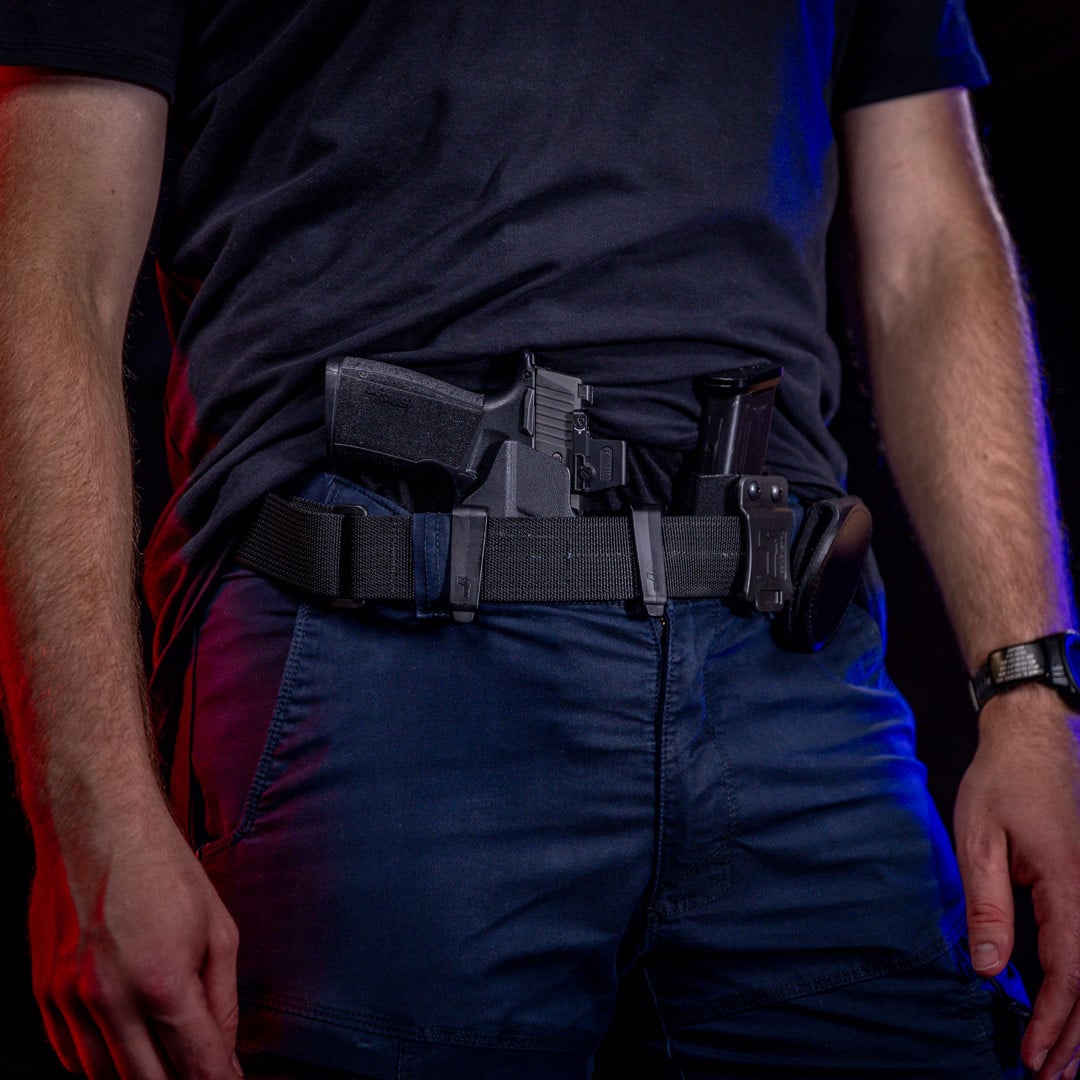
What Kydex Holster Should I Buy?
If you carry concealed, the holster you choose matters as much as the gun itself. A Kydex IWB holster is the most popular choice for everyday carry for good reason: it's rigid, durable, low-profile, and purpose-built for a specific firearm. But not all Kydex IWB holsters are created equal, and the difference between one that genuinely disappears under your shirt and one that causes you to leave your gun at home is usually in the details.
This guide covers everything you need to know about Kydex IWB holsters — what to look for, how to set one up for comfort and concealment, and why the right holster is a long-term investment worth making once.
What Is Kydex — and Why Does It Dominate IWB Carry?
Kydex is a thermoplastic material that can be vacuum-formed around a specific firearm mold, creating a holster body that fits one gun precisely. It's rigid, lightweight, moisture-resistant, and holds its shape indefinitely — which matters both for consistent retention and for safe re-holstering. Unlike soft leather or nylon, a Kydex shell won't collapse after a draw, meaning you can re-holster one-handed without fishing the opening open.
(DISCLAIMER: KYDEX® sheet is a registered trademark of SEKISUI KYDEX, LLC.)
For inside-the-waistband (IWB) carry, those properties translate into real-world advantages:
- Low profile — less bulk between your body and your clothing
- Passive retention that holds the gun exactly the same way every time
- No moisture absorption, so sweat won't degrade the holster or the gun's finish
- Consistent trigger guard coverage — a critical safety feature for any carry holster
The tradeoff is comfort against your skin. Kydex is harder than leather, so holster design — specifically the cut, the edge finishing, and where material contacts your body — matters more in a Kydex IWB holster than in almost any other category. This is where quality manufacturers separate from budget options.
IWB vs. AIWB: Carry Position Explained
IWB simply means inside the waistband — the holster rides inside your pants, typically held in place by one or two belt clips. Where on your body determines the carry position:
Strong-Side IWB (3–4 o'clock)
The classic position is sitting near your dominant hip. Natural for right-handers, familiar from duty carry, and easy to access. The gun sits behind your hip, which means a slightly longer draw stroke. Strong-side IWB pairs well with most belt-clip holsters and works across a wide range of body types.
Appendix IWB (AIWB, 12–2 o'clock)
Appendix carry has become the dominant position for serious concealed carriers over the last decade. The holster sits in front of your hip or across the centerline, which puts the gun closer to your hands for a faster draw, makes it easier to retain the gun in a struggle, and — counterintuitively — often conceals better under a t-shirt because the natural drape of fabric in front covers the grip.
AIWB holsters benefit from a claw or wing attachment (more on that below) and often feature a slightly different geometry — a shorter length, more aggressive cant, and sometimes a wedge to tilt the muzzle end away from your body. If you plan to carry appendix, look for holsters specifically designed for AIWB or that offer position-specific accessories.
Kidney Carry (4–5 o'clock)
Kidney carry pushes the holster further behind the hip, roughly over the kidney. It works well for seated carry and for those who find 3-4 o'clock uncomfortable, but requires a longer reach on the draw and can be harder to access under a seatbelt.
The Features That Separate a Good Kydex IWB Holster from a Great One
Adjustable Retention
Retention is how firmly the holster holds the gun. A quality Kydex IWB holster uses a friction-fit retention system controlled by a tensioning screw — typically at the trigger guard. Too loose and the gun shifts; too tight and you're fighting the holster on the draw. A good holster lets you tune retention to your preference and re-adjust over time as the Kydex breaks in slightly with use.
As a starting point, your holster should pass the "shake test" (gun doesn't fall out when inverted) while allowing a clean, single-handed draw at a comfortable grip-breaking pace.
Cant Adjustment
Cant is the angle at which the gun sits relative to vertical. A holster at 0-degree cant is straight up and down; positive cant (FBI tilt) angles the muzzle forward. Most IWB holsters offer adjustable cant, typically from 0 to around 30 degrees.
For appendix carry, a slight forward cant — 10 to 15 degrees — makes the grip easier to access while keeping the gun close to the body. For strong-side carry, many carriers prefer less cant or none at all. The ideal setting is personal and depends on your body geometry, clothing, and draw stroke, which is why adjustability matters.
The Claw (Concealment Wing)
A claw is a small plastic attachment that extends from the holster body and presses against the inside of your belt. When the belt tightens, the claw levers the grip inward toward your body, reducing the outward print of the grip through your shirt.
For appendix carry, a claw is essentially non-negotiable if you want to carry under a t-shirt without obvious printing. For strong-side carry, it's helpful but less critical because the gun sits behind your hip where the curve of your body already helps conceal it.
Some manufacturers build the claw into the base holster; others offer it as a modular add-on. The modular approach has a genuine advantage: you can tailor the system to your carry position, add different claw sizes for different clothing, and keep the base holster simpler and lighter when you don't need it.
Sweat Guard
The sweat guard is the portion of the holster that extends above the slide between the gun and your body. It protects your firearm from sweat and prevents the slide from digging into your skin. Most Kydex IWB holsters include at least a partial sweat guard; full-coverage guards are more comfortable for some carriers but can slightly obstruct the draw stroke. A half-guard is the practical middle ground for most people.
Belt Clips and Loops
How the holster attaches to your belt has a significant effect on stability, ease of on/off, and print. The most common options:
- Single clip — lighter, lower profile, faster on/off, but can allow more movement
- Dual clip — more stability, better for heavier guns or active use
- Soft loops — require threading the belt, but eliminate any gap between the holster and pants for minimal print
J-hooks and standard clips are typically compatible with belts up to 1.75 inches wide. If you carry with a dedicated gun belt (which you should), confirm the clip width before buying.
Optic Cuts and Light Compatibility
If your pistol has a red dot optic or a weapon light, you'll need a holster specifically cut for it. Most quality manufacturers now offer optic-ready and light-bearing variants at the time of order — but verify before you buy. A holster cut for a bare pistol won't fit a light-equipped gun and vice versa.
How to Set Up Your IWB Holster for All-Day Comfort
Most comfort problems with Kydex IWB holsters aren't holster problems — they're setup problems. When a new holster feels uncomfortable, work through these variables before writing it off:
Start with retention slightly looser than you think you need. Brand-new Kydex can feel stiff; it breaks in quickly with repeated draws. Set the retention screw so the gun seats fully but comes out with a clean, deliberate pull — then tighten gradually if needed.
Adjust cant before position. Most people chase the right carry position when the problem is actually cant angle. Try 10-15 degrees of cant and see if the grip feels more natural against your body before moving the holster around your waistband.
Ride height matters more than most people realize. A holster riding too low makes the draw harder; too high, and the grip digs into your ribs when seated. Adjust so the top of the grip clears your waistband slightly with your shirt tucked in, and re-evaluate for seated comfort.
Don't skip the gun belt. A quality 1.5" or 1.75" gun belt stiffens the waistband, keeps the holster from collapsing inward, and distributes weight evenly. Carrying with a fashion belt undermines even the best holster setup.
Common Mistakes New Carriers Make
Buying based on price alone. Budget Kydex holsters often use thicker, less precisely formed shells, inferior clips, and skip features like adjustable cant. A holster you'll actually wear every day is worth the extra $20-30 over one that ends up in a drawer.
Ignoring carry position when choosing a holster. A holster designed for strong-side hip carry often has the wrong geometry for AIWB — different cant range, different clip placement, no claw compatibility. If you plan to carry appendix, buy a holster built for it.
Skipping the break-in period. Kydex retention is stiff when new. Dry-fire draw practice for a few hundred reps will break in the holster naturally and let you fine-tune retention before you go to the range.
Not verifying fit for your specific pistol variant. A holster listed for the Glock 19 may or may not fit the Glock 19 MOS (optic-cut slide). Always check that the specific variant you carry — including any mounted accessories — is listed in the fit guide.
Why Made-in-USA Kydex Holsters Are Worth Seeking Out
The concealed carry market is flooded with imported holsters that mimic the form factor of American-made Kydex at a fraction of the cost. The difference shows up in tolerances. Domestic manufacturers using CNC-machined molds and vacuum-forming tooling built around specific firearm samples produce holsters that fit more precisely — with tighter trigger-guard coverage, better retention geometry, and edges finished to a standard that doesn't abrade against your skin or clothing.
Beyond fit, buying from a domestic manufacturer means you're dealing directly with the company that designed the product when something needs to be resolved. The concealed carry community has clear preferences here: brands with real customer service and responsive warranty support consistently outperform competitors on long-term reputation, even when the product specs are similar on paper.
What to Expect to Pay for a Quality Kydex IWB Holster
Quality Kydex IWB holsters from reputable domestic manufacturers generally run between $60 and $100. Below that range, you're typically getting imported product, inferior clips, or less precise molding. Above it, you're moving into custom-shop territory — longer lead times, more options, but diminishing real-world returns for most carriers.
The $65-85 tier is where most of the best everyday-carry options live. At this price point, you should expect gun-specific Kydex molding, adjustable retention, adjustable cant, a quality belt clip, full trigger guard coverage, and a warranty that means something.
How Tulster Approaches Kydex IWB Design
Tulster was built on a simple premise: a concealed carry holster should disappear. The founder started carrying in 2004, grew frustrated with bulk and poor retention, and built the first Tulster holster in a two-car garage in Jenks, Oklahoma. That origin — maker-first, function-over-features — still shows up in the product.
The Profile IWB Holster uses .08" Kydex, which is thinner than most competitors without sacrificing rigidity. Extra material at the muzzle is trimmed away, not just because it looks cleaner, but because that's where Kydex digs into the lower abdomen in AIWB carry. The trigger guard undercut promotes a higher grip on the draw — a small detail that most holster buyers don't think to look for until they've drawn from a few thousand reps and noticed their grip is consistently low.
Cant adjusts from 0 to 30 degrees on the same clip without tools. The clip design stays flush against the pants, minimizing the gap that causes print through tighter clothing.
For carriers who want a claw, Tulster offers the SideKick as a modular add-on rather than building it into the base holster. The reasoning is consistent with the broader design philosophy: add what you need, carry what you actually use, and don't pay for material you're going to remove anyway. For AIWB carriers who live in a t-shirt, the SideKick claw makes a visible difference in grip-print reduction. For strong-side carriers who don't need it, the base holster stays slim. This is the reason we created The Tulster Wedge.
The wedge is a foam attachment that pulls the grip closer to your body while pushing the muzzle away from you. This reduces printing and hotspots on your carry setup.
The OATH IWB Holster, Tulster's other flagship model, adds a soft backing layer against the body for extended-wear comfort — a good option for carriers who find straight Kydex against the skin uncomfortable after hours of daily carry.
Every holster ships same day from the Oklahoma facility, comes with a lifetime warranty, and is returnable without the bureaucracy that makes dealing with gear companies frustrating. For a product you're trusting with personal safety, that matters.
In Conclusion
A great Kydex IWB holster is one you actually carry every day. That means it has to fit your gun precisely, sit comfortably against your body, conceal without printing, and allow a consistent, clean draw. The features that make that happen — precision molding, adjustable retention and cant, a well-executed claw option, quality clips — are worth paying for once rather than cycling through cheaper options that send you back to the search.
If you've been carrying with a factory holster or a budget import, the difference a purpose-built Kydex IWB makes is immediate. Less print. Less fidgeting. More confidence that what you're carrying is working with you, not against you.
Explore Tulster's IWB holster lineup here — same-day shipping, lifetime warranty, made in Oklahoma.