



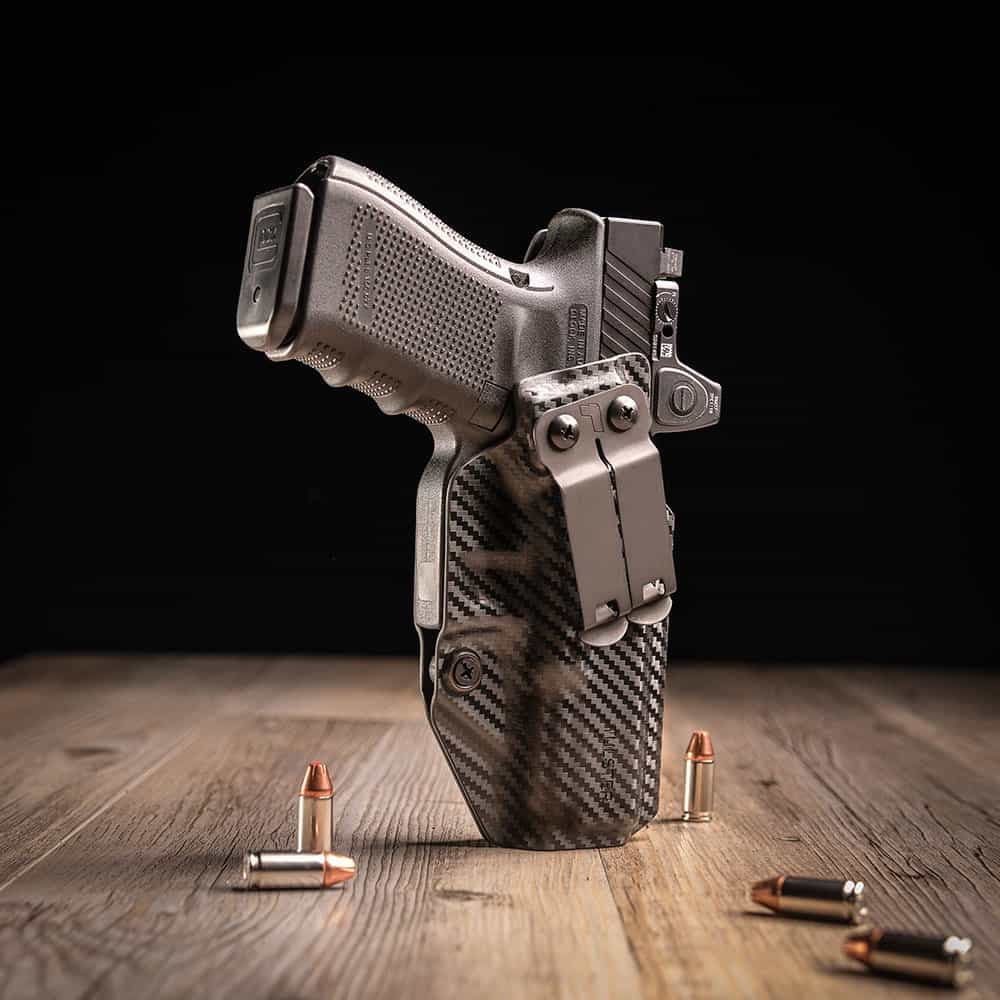
From Austrian Workshop to America's Carry Gun
If you carry a Glock today, there's a decent chance you've never thought twice about where the design actually came from. The answer surprises most people: Gaston Glock, the man whose name is now stamped on one of the most recognizable pistols on earth, had never designed a firearm in his life before he built the Glock 17. He ran a small manufacturing company outside Vienna making curtain rods, knives, and machine-gun belt links — and that background in polymer and metal fabrication is exactly what let him build something the firearms industry hadn't seen before.
This is the story of how that happened, how the Glock ended up on the hip of roughly two-thirds of American law enforcement, and how the platform evolved into the slim, concealable pistols — like the Glock 43X — that a huge share of today's concealed carriers actually carry.
Who Invented the Glock?
Gaston Glock founded his company, Glock Ges.m.b.H., in Deutsch-Wagram, Austria, in 1963 — almost two decades before the pistol that made his name existed. The early business produced consumer goods and military hardware: field knives, grenade casings, and machine-gun belt links. None of it involved firearms.
That changed in 1980, when the Austrian military opened a competition for a new standard-issue sidearm. Glock had no handgun engineering experience, so he did what a craftsman does when he's solving an unfamiliar problem — he brought in people who did. He hired engineers who had worked on Heckler & Koch's early polymer-frame pistols and set out to design something that could pass brutal military durability testing while using the injection-molding expertise his company already had.
It took about a year. Glock filed the Austrian patent for the design in April 1981, and the pistol — chambered in 9x19mm — entered the Austrian military and police service in 1982. He named it the Glock 17 because it was his 17th patent, not because of its magazine capacity, though the fact that it happened to hold 17 rounds didn't hurt the legend that grew up around the name.
The Innovation That Actually Mattered: Polymer and the Safe Action Trigger
The Glock 17's real breakthrough wasn't a single feature — it was a manufacturing philosophy. Most pistols at the time were machined almost entirely from steel, which made them heavy, expensive to produce at scale, and slow to manufacture. Glock built the frame from a high-strength polymer, using the same injection-molding know-how that had gone into his curtain rods and knife handles years earlier. The result was a pistol that was significantly lighter than its steel-framed competitors, cheaper to produce in volume, and — critically for a military buyer — just as durable under abuse.
The second piece was the Safe Action trigger system: no external manual safety, no separate decocker, just a striker-fired design with internal safeties that disengage only when the trigger itself is pulled. It simplified training, reduced the number of steps between "gun in hand" and "gun firing," and became one of the most copied trigger philosophies in the industry's history.
Neither idea was entirely new in isolation. What was new was building an entire service pistol around both of them at once, and getting a military procurement board to trust it.
From Austrian Service Pistol to American Law Enforcement Standard
The Glock 17 passed NATO's durability testing in 1984, and Norway adopted it as its standard sidearm shortly after — the first sign that this wasn't going to stay an Austrian-only story. Glock opened its U.S. headquarters in Smyrna, Georgia, in November 1985, betting on the American market before most of America had heard the name.
The event that actually broke the dam was tragic and, in retrospect, pivotal for the entire handgun industry: the 1986 FBI Miami shootout, where two agents were killed and five wounded in a gunfight that exposed serious shortcomings in the revolvers and underpowered semi-autos most agencies still carried. The shootout accelerated a nationwide shift toward higher-capacity semi-automatic service pistols, and Glock was positioned exactly right when it happened. The Miami Police Department became one of the first major agencies to adopt it, ordering 1,100 pistols. Through the late 1980s and into the '90s, agency after agency followed.
By the time the dust settled, GLOCK pistols had been adopted by an estimated 65% of U.S. law enforcement agencies — a market share no single handgun maker had approached before, and one that turned "Glock" into something closer to a category name than a brand name, the way "Kleenex" or "Band-Aid" became shorthand for the product category itself.
The Platform Grows: From the 17 to the Slimline Era
Once the Glock 17 proved the formula worked, the company spent the next three decades building variations on it rather than reinventing it — a compact (Glock 19), a subcompact (Glock 26), different calibers, different frame sizes, eventually optic-ready MOS cuts as red dots became mainstream on duty and carry guns. The core engineering — polymer frame, Safe Action trigger, minimal controls — stayed remarkably consistent across nearly every model that followed.
The shift that mattered most for today's concealed carry market came in January 2019, when Glock unveiled the Glock 43X at SHOT Show, with a wider release that July. The 43X kept the original Glock 43's slim, single-stack slide — about 6 inches long and 0.87 inches wide — but added roughly 0.79 inches to the grip length, enough for most shooters to get a full, three-finger purchase on the draw instead of fighting a stubby grip. Capacity jumped to 10 rounds, up from the Glock 43's 6, without giving up the slim profile that makes a single-stack pistol easy to conceal in the first place.
Glock built the 43X as part of its Gen 5 lineup, which meant an ambidextrous slide stop, a flared magwell for faster reloads, and the removal of finger grooves on the grip — small changes individually, but ones that added up to a notably easier gun to shoot well for a wide range of hand sizes. The MOS variant, which followed, opened the door to slide-mounted red dots on a gun that size — a feature that would have been almost unthinkable on a carry pistol this slim a decade earlier.
The 43X landed at exactly the moment the concealed carry market was shifting toward higher-capacity micro-compacts, and it became one of the most carried 9mm pistols in the country almost immediately. It's also not coincidentally, one of the pistols Tulster builds the most holster variations for.
Why a Great Pistol Still Needs the Right Holster
Here's the part of the Glock story that doesn't usually make it into the history books: the gun is only half of the carry equation. A Glock 43X holstered in a bulky, poorly trimmed holster loses most of what made the pistol worth choosing in the first place — the slim profile, the easy concealment, the fast draw. The holster either protects that design intent or actively works against it.
That's the problem Tulster was built to solve. We built six distinct holster options for all available Glock models, including the Glock 43X, out of our shop in Jenks, Oklahoma, covering the way people actually carry this gun:
- Profile — our minimalist IWB holster, trimmed close with no excess Kydex and an undercut trigger guard for a higher, faster grip on the draw. The default answer for everyday concealed carry.
- Profile+ — the same minimalist Profile build with an optic-ready cut, for MOS owners running a red dot who don't want to give up the smallest possible footprint.
- OATH — a fully ambidextrous, optic-ready IWB holster with adjustable retention shims, built for shooters who want more control over draw resistance out of the box.
- ARC — IWB options built around a mounted weapon light, sized for Streamlight and SureFire variants.
- Contour — a concealed OWB option that adheres to the curve of your hip for maximum concealment.
- Range+ — OWB options for range training, competition, and open carry, both cut for MOS-equipped Glock pistols.
Every one of those holsters ships with a lifetime warranty, free same-day shipping, and hassle-free returns, because a holster is a piece of safety equipment, not just an accessory — and we'd rather you spend your time figuring out which build fits your carry style than worrying about whether it'll hold up.
The Throughline
From a curtain-rod manufacturer in Deutsch-Wagram to the sidearm carried by most American police departments to the slim, optic-ready pistols a huge share of civilian concealed carriers choose today, the Glock story is really a story about one engineering bet — that a pistol built from polymer and a simplified trigger system could outperform decades of steel-framed convention, paying off again and again as the platform evolved. And now with the Glock Gen 6 here, the story continues.