



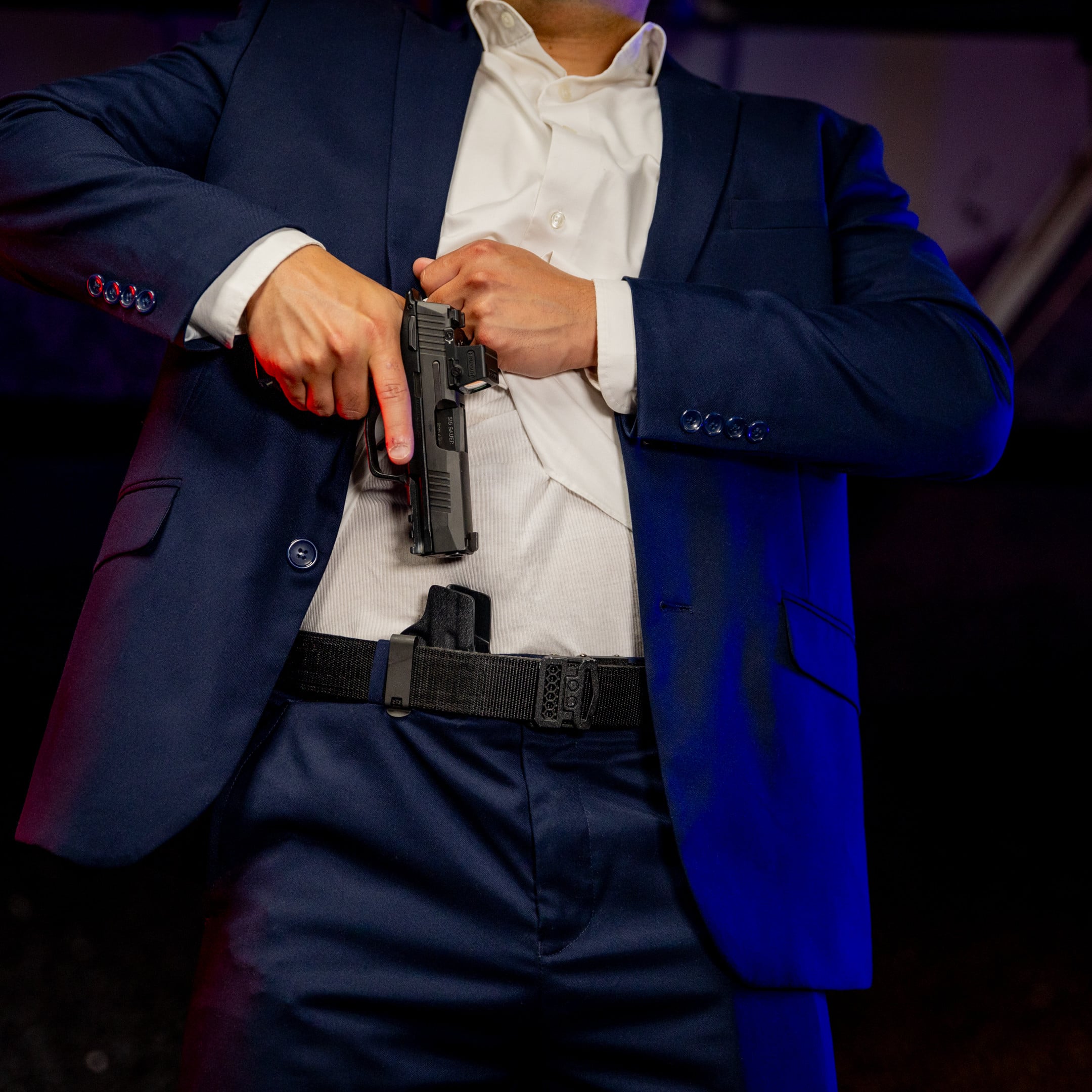
Can You Tuck a Shirt Over a Concealed Carry Holster? Meet the OATH
Quick answer
Yes — the Tulster OATH is a tuckable IWB holster, meaning it's engineered to let you carry concealed with your shirt tucked in, not just untucked. Most inside-the-waistband holsters assume you're wearing an open or untucked cover garment. The OATH's DCC MOD4U steel clip and pre-installed ModWing are built specifically so the holster and clip sit low and tight enough to disappear under a tucked-in shirt, which makes it one of the few holsters on the market suited for office environments, client meetings, or any business-casual dress code where concealed carry usually gets complicated.
Most people who start carrying concealed figure out the tucking problem the hard way — usually in a work bathroom, five minutes before a meeting, realizing that the holster that worked fine with an untucked flannel on the weekend is now printing through a dress shirt like a coat hanger. It's one of the most common frustrations in concealed carry, and it's also one of the most avoidable, if the holster is actually built for it.
The OATH is Tulster's answer to that specific problem. It's not a general-purpose IWB holster that happens to tuck in a pinch — tuckability is a core design requirement, built into the clip, the wing, and the overall profile from the start. If you've read Tulster's OATH vs. Profile+ comparison, you already know the OATH trades some of the Profile+'s on-the-fly adjustability for maximum concealment and a tuckable build. This post goes deeper on that one feature, because for a meaningful chunk of concealed carriers, tuckability isn't a nice-to-have — it's the deciding factor in whether they carry at all on a given day.
Why most IWB holsters aren't actually tuckable
"IWB" (inside the waistband) gets used as shorthand for "concealable," but inside-the-waistband and tuckable are not the same thing. An IWB holster rides inside your pants against your body, which is a good start for concealment — but most IWB clips are wide, tall, or shaped in a way that assumes a shirt is going to drape over the outside of your belt, not get tucked underneath it.
Try to tuck a shirt over a standard belt clip, and you usually get one of two results: a visible bump or ridge where the fabric bunches around the clip, or a clip that's simply too bulky to tuck under comfortably in the first place. That's why so much concealed carry advice defaults to "wear an untucked shirt" or "carry a jacket" — it's a workaround for holster hardware that was never designed to disappear under tucked-in clothing.
A genuinely tuckable holster has to solve this at the hardware level: a low-profile clip that sits flat against the belt, a body shape that doesn't add width where the shirt has to fold over it, and a claw or wing system that pulls the grip in tight enough that there's no gap to print. Get any one of those wrong and "tuckable" is just a word on a product page.
What makes the OATH tuckable
The DCC MOD4U clip
The OATH ships with a DCC MOD4U steel clip — a low-profile metal clip built from a high-strength steel alloy specifically designed to sit flat and stay put under a tucked shirt. Reviewers have noted the clip "locks firmly in place and does not slide around your belt," which matters twice over for tucked carry: once for retention, and once for keeping the holster from shifting and creating a visible bulge as you move through the day. The clip's ride height is adjustable, so you can raise or lower the holster to find the position where it sits flattest against your body — a small adjustment that makes a real difference once there's fabric folded over the top of it.
The pre-installed ModWing
Every OATH ships with a ModWing already installed — a medium 3/8" insert out of the box, with a larger 1/2" insert included in the box if you want more aggressive concealment. The wing pushes against the back of your belt, which levers the grip of the pistol in toward your body instead of letting it kick outward. That's the difference between a holster that conceals fine with a loose t-shirt and one that conceals under a fitted dress shirt: the wing does the work of eliminating the gap that would otherwise show up as printing, and it does it without adding bulk to the holster body itself.
One reviewer at The Armory Life put it plainly after running the OATH with a Springfield Hellcat and an extended 13-round magazine: he could conceal it "without so much as a bump showing through my shirt." That's the ModWing doing its job on one of the harder cases — a longer magazine that gives the gun more grip to hide.
A minimal, .08" Kydex build
Underneath the clip and the wing, the OATH is molded from .08" Kydex — thick enough to hold its shape and retention over years of daily use, but molded with Tulster's standard minimalist approach: no excess material, a matte-edge hand-buffed finish, and Tulster's signature undercut trigger guard, which lets your hand get a full, high grip on the pistol the instant it clears the holster. None of that is unique to the OATH — it's the same construction standard across Tulster's lineup — but it's worth noting that tuckability doesn't come at the cost of the build quality the brand is known for. You're not trading a thinner, flimsier holster for a tuckable one.
Built for the rest of EDC, not just tucking in
A holster that only solves one problem well isn't actually good for everyday carry — EDC means the holster has to work across a whole range of situations, not just the one it was designed around. The OATH holds up on the rest of the list:
Adjustable, fixed retention. The OATH uses multi-stage retention set with included shims — tighten fully for maximum security, or use the shims to dial in a lighter draw. Once it's set, there's nothing to fidget with day-to-day, which is one less variable when you're also managing a tucked-in shirt and a belt clip.
True ambidextrous carry. The OATH's hardware can be relocated from one side to the other, so the same holster works for right- or left-handed carry. That matters for anyone buying for a household with mixed-handed shooters, or for someone who simply doesn't want to reorder if their carry side ever changes.
Optic-ready out of the box. The OATH includes a generous optic cut that accommodates common red dot footprints like the Trijicon RMR and SRO, along with a raised sight channel for suppressor-height sights and an open-ended muzzle for threaded barrels. If your carry pistol runs a red dot, you're not stuck choosing between an optic and a tuckable holster.
A shape built for sitting, driving, and moving. A reviewer at GunSpot named the OATH his "New Favorite Holster", specifically citing the adjustable ride height and contoured edges for comfort while sitting and driving — the parts of the day that expose a poorly shaped holster fastest.
What carriers who've actually worn it are saying
The tuckability claim isn't just a spec on a product page — it holds up in independent reviews, including from Shooting Illustrated, an official NRA publication, which called out tuckability as a feature "we see less frequently in the holster world" and concluded that "if you're overly concerned about printing, this might be one of the best options on the market."
At The Square Reviews, a reviewer who carried a Glock 43 in the OATH for several months called it "a great option if you're going to be in business or business casual attire that requires a shirt tuck," and noted that with the wing and clip working together, "the unit did not migrate much at all" — exactly the stability you need when there's fabric layered over the top of it all day.
Backed by more than the design
Tuckability solves a specific, real problem, but it's worth remembering the OATH also comes with the same operational backing that runs across everything Tulster makes: free same-day shipping, a product lifetime warranty, hassle-free returns, and manufacturing entirely in the USA, out of the same Jenks, Oklahoma shop the company has run since it started as one founder's fix for a bad factory holster. Pricing runs $74.99 to $84.99 depending on configuration — a fair number for a holster that includes the clip, the wing inserts, and the retention shims rather than charging extra for each piece separately.
Frequently asked questions
Can you tuck a shirt in over a concealed carry holster? With most IWB holsters, not comfortably — standard clips are too tall or bulky to tuck under cleanly. The OATH is a specific exception: its low-profile DCC MOD4U clip and ModWing are designed to let you tuck a shirt in while carrying concealed.
Is the OATH holster ambidextrous? Yes. The OATH's hardware can be relocated from one side to the other, so a single holster works for both right- and left-handed carry.
Does the OATH work with a red dot optic? Yes. The OATH includes a generous optic cut that fits common red dot footprints like the Trijicon RMR and SRO.
Is the OATH's retention adjustable? Yes. The OATH uses multi-stage fixed retention: tighten fully for maximum security, or use the included shims to set a lighter draw. It's a set-it-and-forget-it system rather than an on-the-fly adjustment.
How much does the Tulster OATH holster cost? OATH pricing runs from $74.99 to $84.99 depending on the pistol model and clip configuration, and every OATH includes free same-day shipping, a lifetime warranty, and hassle-free returns.
Is the OATH good for office or business casual carry? Yes — this is the scenario the OATH is specifically built for. Its tuckable clip and wing system make it one of the better IWB options for carriers who need to wear a tucked-in dress shirt regularly.
The bottom line
Concealed carry shouldn't force a choice between dressing the way your day requires and carrying the way you want to. The OATH exists because that trade-off is real for a lot of people — and because most holster makers solve it by telling you to wear a different shirt instead of building a holster that works with the one you already have on. If tucking in is part of your routine, the OATH is built around that fact rather than around it.
Shop the OATH series and find the configuration built for your pistol.